

























Imagine your toddler’s face when they realize the hero in their favorite story shares their name, their favorite blue sweater, and even their love for building block towers. You’ve likely felt the frustration of reading a generic book while your little one’s eyes wander toward a toy instead of the page. It’s common for toddlers to lose interest in stories that don’t reflect their daily lives. High-quality personalized books for toddlers can help by placing your child at the center of the narrative, making the story feel more familiar and fun.
You’re looking for a book that is both educational and durable, yet you might have concerns about data privacy or ending up with a low-quality novelty gift. This guide will show you how to choose custom storybooks that boost engagement and build lasting family memories. We’ll explore how to select stories that mirror your child’s emotional world, how to choose between photo and no-photo customization, and what to look for in a keepsake designed to last for years. You’ll soon have the tools to create a storybook your child may want to return to again and again.
Key Takeaways
- Learn how seeing themselves as the protagonist can support a toddler’s self-recognition and emotional development.
- Discover how avatar-based and photo-based personalization differ, and why some families prefer a no-photo option for toddler storybooks.
- Compare the benefits of digital story access, printed keepsake options where available, and screen-free reading routines.
- Identify how to match story themes to your child’s specific milestones or current obsessions to keep them engaged.
- Explore the simple steps to create a custom story that reflects your child’s unique appearance and personality.
Table of Contents
Why Personalized Books for Toddlers Support Early Development
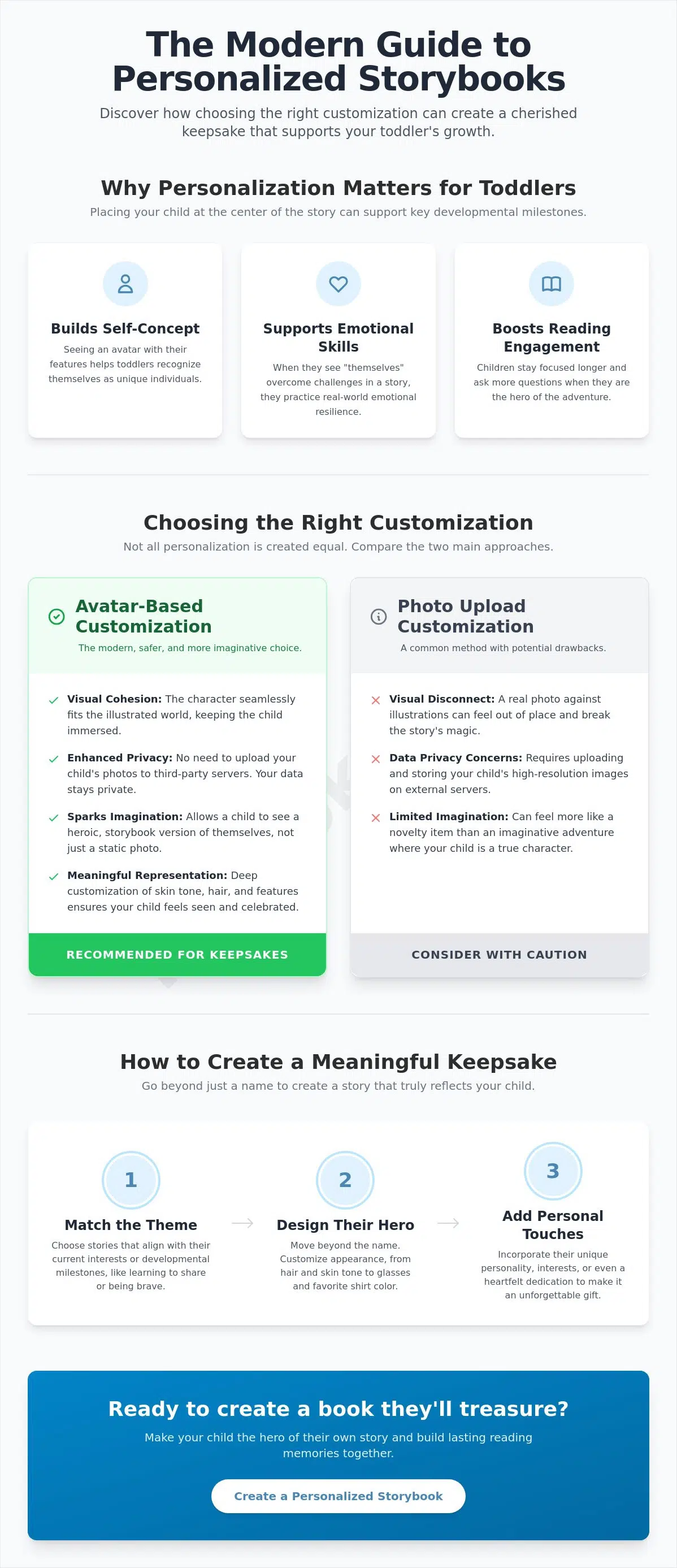
At their core, what are personalized books? They are narratives where your child is the central protagonist rather than a bystander. In personalized books for toddlers, the story isn’t about a generic animal or an anonymous character; it’s about your child. This shift from observing to participating changes how a toddler processes information. By placing them at the heart of the action, these stories create a bridge between the imaginary world and their own reality.
Between the ages of one and three, children begin to recognize themselves as distinct individuals. Seeing an avatar that shares their hair color or hearing their name read aloud can reinforce this growing self-concept. It can support early learning by helping them visualize themselves in different scenarios. When a child sees “themselves” overcoming a hurdle, they aren’t just listening to a story; they’re practicing the emotional skills needed to handle real-world challenges.
Early literacy skills often depend on a child’s interest level. Most parents are familiar with the “toddler wiggle” during storytime. However, children often show higher levels of reading engagement when they are the stars of the show. They tend to point more, ask more questions, and stay focused for longer periods. This transition from passive listening to active engagement is a crucial step in developing a lifelong love for reading.
The Role of the Protagonist in Toddler Learning
Children relate most deeply to characters who share their immediate world. By using a customized avatar and name, you create a “mirror effect” that helps the child connect with the narrative. MIBOOKO’s research-informed approach is based on the idea that intentional design principles in children’s literature can help foster a stronger emotional connection to the story. When the protagonist looks like them, the emotional stakes of the plot feel personal and relevant to their daily life.
Moving Beyond Generic Bedtime Stories
Generic characters in mass-produced books are often static and disconnected from a child’s specific life. They don’t know your child’s favorite activities or their unique personality traits. Personalized books for toddlers turn a routine evening ritual into a dynamic, interactive experience. Your little one is much more likely to sit through a book when they are the ones exploring the forest or solving a puzzle. These stories act as mirrors for a child’s emerging identity, reflecting back their potential and their place in the world.
Choosing the Right Customization: Photo and No-Photo Options
When you begin searching for personalized books for toddlers, you’ll generally encounter two main styles: those that require a photo upload and those that use a custom-designed avatar. While seeing a real photo might seem like the ultimate personalization, it often creates a visual disconnect. Photos can sometimes feel out of place against hand-drawn illustrations. This can pull a child out of the story. An avatar-based book ensures your child looks like they truly belong in the world of the narrative. This cohesive look helps them focus on the adventure rather than the novelty of the photo.
Choosing an avatar also supports your child’s imagination. It allows them to see themselves as a hero version of themselves. It’s vital that these avatars represent diverse skin tones and hair types accurately. When a child sees a character that reflects their heritage and features, it builds a sense of belonging. This representation is a key part of the early development benefits of reading, as it fosters a positive self-image and deeper narrative connection.
Privacy and Safety in Digital Customization
Many parents feel uneasy about uploading high-resolution photos of their children to third-party servers. It’s a valid concern. Your child’s digital footprint is something to protect from day one. This is why MIBOOKO’s methodology and safety standards include a privacy-conscious no-photo option while still allowing families to personalize the child with or without a photo. MIBOOKO lets parents personalize the child with or without a photo, so families can choose the creation path they are most comfortable with while still creating a character designed to feel familiar and personal. This approach also allows the story to focus on emotional growth and personality traits, which are far more meaningful than just a physical likeness.
Creating a Hero That Looks Like Your Toddler
Designing the character can be a joyful bonding activity. You can involve your toddler by asking them which hair style looks most like theirs or what color shirt they want to wear. Use this simple checklist to guide the process:
- Skin tone: Select a shade that matches their unique complexion.
- Hair: Choose from various textures, lengths, and colors.
- Interests: Select themes like space, animals, or nature that resonate with them.
Including their interests is just as important as their physical appearance. If your child loves dinosaurs, seeing themselves as a dino-explorer makes the book a treasure. You can create a personalized storybook for your child that captures these small details perfectly, ensuring they remain the heart of every page.
Evaluating Formats: Paperback/Hardcover, Digital, and Personalized Audiobooks
Choosing the right format for personalized books for toddlers is just as important as the story itself. While digital versions offer faster access, a physical book provides a tactile experience that helps a child develop fine motor skills. Toddlers learn by touching, turning pages, and pointing at illustrations. This physical interaction is a core part of the benefits of creating personalized books, as it turns reading into a sensory activity. Beyond the traditional book, modern options like personalized audiobooks and “endless books” offer new ways to keep the narrative alive in your child’s daily routine.
The Durability Factor for Toddler Hands
Toddlers aren’t known for being gentle with their belongings. A paperback might be lightweight, but it rarely survives the “enthusiasm” of a two-year-old. Premium hardcover books are the gold standard for nursery libraries because they withstand repeated reading and rough handling. You should look for options with thick, high-quality paper that can survive “peanut butter fingers” and the occasional tug-of-war. For parents seeking a lasting gift, you can explore the personalized storybook guide to understand which story format best fits your child’s reading routine and keepsake expectations.
The Rise of Personalized Audio for Little Ears
Personalized audiobooks are becoming a favorite tool for parents who want to reduce screen time. Unlike a generic story, a personalized MIBOOKO story uses your child’s name and selected details throughout the adventure. Hearing their own name read aloud can support auditory processing and keeps them focused during long car rides or quiet time at home. It’s a screen-free “parent lifesaver” that allows the story to continue even when you can’t be there to hold the book. These audio experiences turn a simple trip to the grocery store into a personal mission where your child is the star.
Another emerging concept is the “endless book.” These are designed for recurring narrative experiences, allowing the story to evolve or be revisited in different ways. This approach acknowledges that toddlers love repetition; they often want the same story every single night. By offering a narrative that feels fresh yet familiar, you support their need for routine while gently expanding their vocabulary and imagination.
Matching Themes to Toddler Milestones and Interests
Choosing a theme for personalized books for toddlers requires looking beyond what is simply “cute” on a shelf. Between the ages of one and three, children undergo a massive shift in how they view the world. They transition from the simple object-naming of baby books to complex, character-driven narratives. By selecting a theme that mirrors their current obsession, you don’t just grab their attention; you validate their interests. Whether they are fascinated by the garbage truck that visits every Tuesday or the ladybugs in the garden, seeing these elements in a story makes the reading experience feel deeply personal.
Birthday-themed stories remain the most popular choice for gifts, and for good reason. These books serve as a time capsule, capturing a child’s appearance and personality at a specific age. However, for daily reading, look for themes that reflect their emerging sense of self. Toddlers are beginning to understand their role in the family and the community. Stories that feature them as an “everyday hero” helping at home or exploring the playground can support this developmental stage by providing a safe space to explore their growing independence.
Stories for Emotional Growth and Challenges
Toddlers are often overwhelmed by “big feelings” that they don’t yet have the words to describe. This is where skills and challenges books become invaluable tools for parents. When a child sees their own hero character navigating a new experience, it provides a powerful form of behavior modeling. If the character in the book stays calm during a first haircut or feels brave on the first day of daycare, your child can more easily visualize themselves doing the same.
These custom stories are particularly effective for major transitions like potty training or moving to a big-kid bed. Instead of a generic character facing the challenge, it’s your child taking those steps. This familiar narrative can help reduce anxiety and build confidence. It turns a potentially scary milestone into a shared adventure you can discuss together during your evening wind-down.
Popular Adventure Themes for Ages 1-3
Animal and nature themes are highly effective for this age group because they rely on recognizable sounds and vibrant visuals. Toddlers love to mimic the “roar” of a lion or the “hoot” of an owl, making these stories naturally interactive. To add another layer of familiarity, consider how you might incorporate a sibling or a family pet into the narrative. Mentioning a familiar furry friend alongside the child’s avatar creates an immediate emotional hook that generic books simply can’t match.
Focus on stories that celebrate discovery. A simple walk through a park can be a grand expedition when your child is the one leading the way. These narratives encourage curiosity and help toddlers make sense of the environment around them. You can make your child the hero of their own book by choosing a theme that celebrates their unique way of seeing the world.
How to Create a MIBOOKO Keepsake in 2026
Creating personalized books for toddlers should be a simple, rewarding experience that fits into the quiet moments of your day. MIBOOKO uses a streamlined, three-step process to help you build a narrative that feels both familiar and fun. First, you select a story theme that aligns with your child’s milestones, such as a birthday or a new challenge. Second, you customize the hero’s appearance and interests, ensuring they see a character that truly represents them. Finally, you add a heartfelt dedication that turns the book into a lasting treasure. This human-centered approach ensures that technology remains a tool for connection rather than a hurdle.
Personalizing Beyond the Name
A name is just the beginning of the story. You can choose specific emotional focuses to help your child navigate their world, whether that means practicing patience or discovering bravery. These choices influence the narrative arc, making the story a relevant tool for development. You can also select specific interests, from curious animals to backyard adventures, to keep your little reader engaged from start to finish. Adding a custom dedication provides a space for you to share a personal message that your child will grow to appreciate over time. You can learn more about how MIBOOKO works to see how we blend these details into a cohesive, professional design.
The MIBOOKO Assurance: Quality and Heart
We understand that a book for a toddler is more than just paper and ink; it’s a facilitator of meaningful family moments. This is why we prioritize quality standards that exceed typical novelty gifts. Our stories are built on research-backed narrative structures that act as an expert mentor for your child’s emotional growth. These are high-quality keepsakes designed to survive the energetic handling of a busy nursery. To help you feel confident in the digital story experience, MIBOOKO provides a refund guarantee for e-books.
Your child’s imagination is a precious gift. By choosing personalized books for toddlers that mirror their internal world, you give them the confidence to see themselves as the hero of any adventure. It’s time to create a bedtime ritual that your child will look forward to every night. Create a personalized storybook for your child and watch them discover the joy of seeing themselves in the heart of the story.
Give Your Child the Gift of a Familiar Hero
Choosing the right story means looking for a narrative that mirrors your toddler’s emotional world and daily life. By selecting personalized books for toddlers that prioritize a research-backed developmental focus over simple novelty, you create a tool that supports early literacy and self-recognition. You don’t have to sacrifice privacy for a custom experience. A no-photo option can reduce child image-data sharing while still letting them see themselves as the protagonist of a premium storybook or immersive audiobook.
These books are more than just gifts; they are durable keepsakes that facilitate quiet evening rituals and meaningful family moments. When your child sees their name and their likeness on the page, they learn that they are capable of being the hero in any adventure. It’s a simple way to build a library that grows with them and celebrates their unique milestones. Your little reader is ready to discover their place in the heart of the story.
Frequently Asked Questions
Do I need to upload a photo to create a personalized book for my toddler?
No, you don’t need to upload a photo to create a MIBOOKO story, although MIBOOKO can support both photo and no-photo personalization paths. Families who prefer not to upload a child’s photo can use character customization to select details such as hair type, skin tone, and clothing style. This helps parents choose the level of visual personalization they are comfortable with while keeping the illustrations artistic and cohesive throughout the story.
How long does it take to receive a custom storybook?
MIBOOKO e-books are typically prepared in about 60 minutes. If a printed format is available for a specific order or location, any separate production or delivery estimate should be checked at checkout before purchase.
Can I include more than one child in a personalized book?
Many personalized books for toddlers focus on a single protagonist to strengthen the child’s individual connection to the story. However, some of our narrative structures allow you to mention siblings or family pets to make the world feel even more familiar. You can explore the specific options for each story theme during the simple 3-step creation process.
What is the best age to start reading personalized books to a child?
You can begin reading these stories to your child from birth, but the developmental benefits often peak between ages one and four. This is the stage where toddlers begin to recognize their own name and physical features. Seeing themselves as the hero of a story at this age can support their emerging identity and encourage a lifelong love of reading.
Are digital and audio versions available for MIBOOKO stories?
Yes. MIBOOKO offers digital personalized story formats that families can read together through the delivery experience and download for later use. Audiobooks are an excellent screen-free tool for car rides or quiet time, allowing your child to hear their name narrated in the story. These formats work alongside our physical hardcover books to provide a recurring narrative experience across different environments.
What makes a personalized book a better gift than a traditional toy?
A personalized book is a durable keepsake that grows with your child rather than a disposable novelty. It provides a meaningful way to support emotional and cognitive development while building a strong bond during bedtime rituals. While toys are often outgrown, a storybook where the child is the hero remains a cherished part of their childhood library for years.