















The Comfort of the Familiar: Why Bedtime Routines and Recurring Stories Soothe Young Minds
This article is part of the MIBOOKO Storybook series (endless storybook for kids). Start with the parent guide →
It is the end of a long day. The bath is done, pyjamas are on, and the house is finally growing quiet. You settle onto the edge of the bed and reach for a book. Perhaps you suggest a new title from the library, but your child shakes their head and asks for the same story, with the same characters, for the fifth night in a row.
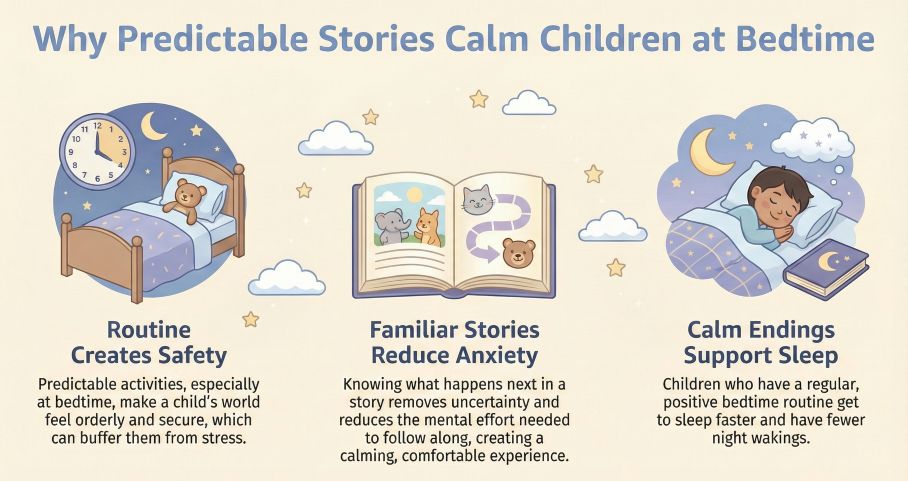 Why predictable stories calm children at bedtime: routine, familiar stories, and gentle endings help children feel safe and ready for sleep.
As parents, we often worry that we should be providing constant variety or educational novelty. However, from the perspective of child development, your child’s request isn’t just a preference—it is a self-regulation strategy. Science tells us that in a big, often overwhelming world, knowing exactly what comes next is the ultimate form of safety.
Here is a look at why predictability and story continuity are powerful tools for helping your child feel calm, regulated, and ready for sleep.
Want the product overview of MIBOOKO Storybook (the endless storybook for kids)? Explore it here →
The Safety of “Knowing What Comes Next”
For a young child, the world is full of new information that must be processed, decoded, and understood. This requires a significant amount of mental energy. When the lights go down, their brains need a break from the “new” to transition into rest.
Predictable routines act as a signal to the nervous system. Research shows that families who maintain consistent routines—specifically around bedtime—create a sense of stability that enhances a child’s emotional well-being. When a child knows that the bath is followed by teeth brushing, which is followed by a story, their stress response system can stand down. This predictability has been directly linked to longer sleep duration and fewer night wakings.
The Science of Soothing: Biological studies on storytelling have found that listening to a narrative can significantly reduce cortisol (the stress hormone) and increase oxytocin (the bonding and calm hormone). The story acts as a physiological regulator, shifting the body from a state of alertness to a state of relaxation.
Why Familiar Friends Reduce Anxiety
Have you ever noticed your child greets a favourite book character as if they were a real friend? In psychology, we refer to this as a “parasocial relationship”. Far from being mere fantasy, these attachments provide a sense of security.
When a child engages with a story featuring recurring characters they already trust, they do not have to expend energy figuring out who is “good” or “safe.” They already know. This familiarity allows them to relax into the narrative. Research indicates that children form attachments to these characters that are similar to real-life friendships, seeking them out for comfort.
If a child is feeling anxious or overstimulated at the end of the day, a new story with unknown stakes can sometimes be too stimulating. A familiar character, however, serves as a secure base, allowing the child to process emotions without fear of the unknown.
The Power of the Continuing Story
While novelty is excellent for learning during the day, story continuity is often better for sleep. Fragmented storytelling—jumping between different worlds, art styles, and rules every night—can sometimes disrupt the “narrative transportation” that allows a child to get lost in a story and forget their immediate stressors.
Engaging in an ongoing narrative (sometimes called “serial storytelling”) allows the child to enter a “flow state” more easily because they already understand the rules of that specific story world. This is where formats that support continuous storytelling can be very helpful for parents. For example, the MIBOOKO Storybook is designed to offer a structured, ongoing story experience. Rather than starting from scratch every night, an ongoing format allows the child to step back into a familiar world, reducing the cognitive load required to understand the setting and allowing them to drift off more peacefully.
For a simple overview of the endless storybook format, see the MIBOOKO Storybook Guide →
Creating a “Safe Harbour” Tonight
You do not need a complex schedule to create a regulating routine. It is about rhythm and connection. Here are a few gentle suggestions for tonight:
1. Honour the Repetition:
If they ask for the same story, say yes. They are likely using it to soothe themselves.
2. Focus on Connection:
The most active ingredient in early development is the “serve and return” interaction between you and your child. Use the story time to cuddle close; physical proximity enhances the release of calming hormones.
3. Keep the sequence:
Try to keep the 2–3 steps leading up to the story consistent. The brain learns to associate this sequence with sleep.
Tonight, when you open that familiar book or continue a beloved story, know that you are doing more than just reading. You are building a predictable, safe world where your child’s mind can truly rest.
References
Aguiar, N. R., Richards, M. N., Bond, B. J., Brunick, K. L., & Calvert, S. L. (2018). Parents’ perceptions of their children’s parasocial relationships: The recontact study. Imagination, Cognition and Personality, 38(4), 1–29.
Brockington, G., Moreira, A. P. G., Buso, M. S., da Silva, S. G., Altszyler, E., Fischer, R., & Moll, J. (2021). Storytelling increases oxytocin and positive emotions and decreases cortisol and pain in hospitalized children. Proceedings of the National Academy of Sciences, 118(22), e2018409118.
Canney, G., & Winograd, P. (1979). Schemata for reading and reading comprehension performance (Technical Report No. 120). University of Illinois at Urbana-Champaign, Center for the Study of Reading.
Digital Wellness Lab. (2023). Children & artificial intelligence: Research brief. Boston Children’s Hospital.
Ferretti, L. K. (2011). The influence of family routines on the resilience of low-income preschoolers [Master’s thesis, Auburn University]. Auburn University Electronic Theses and Dissertations.
Mindell, J. A., Telofski, L. S., Wiegand, M., & Kurtz, E. S. (2009). A nightly bedtime routine: Impact on sleep in young children and maternal mood. Sleep, 32, 599–606.
Sparrow, A. (2025). Storytelling and pain relief. NeuLine Health.
Zimmerle, J. C. (2019). Limiting technoference: Healthy screen time habits for new parents. International Journal of Childbirth Education, 34(2), 54–59.