















Confidence Storybook for Kids
A personalized story that helps your child build confidence and reach potential. It supports a first step when doubt feels strong.
Gentle, age-appropriate, and made for read-together moments.
- Best for: “I can’t”, quitting early, fear of mistakes, low confidence, comparing to others
- Best for ages 3-11+
- Builds confidence through small wins inside the story.
- Great moment: after school, before a new activity, homework time, before practice
Confidence grows through small steps. This story makes small steps feel safe.

Signs your child may need this
This page may help if your child:
Avoids new activities because they may “fail”
Stops quickly when something is not easy
Says “I am not good at this”
Gets upset when corrected
Compares themselves to siblings or classmates
Hides a talent because they feel shy
Needs support to start and continue
What this story helps practice

This confidence storybook for kids helps your child practice:
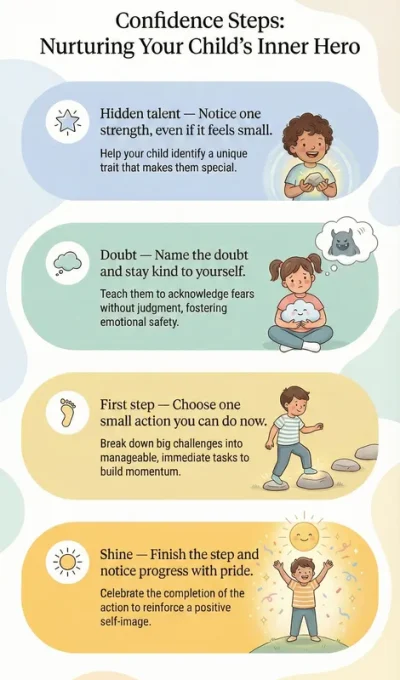
Noticing strengths (small skills also count)
Handling doubt without giving up
Taking one first step (very small and doable)
Finishing one step before moving on
Feeling proud of effort, not only results
How personalization works
Children respond better when the story feels familiar. You choose your child’s name and details, pick a theme your child likes, and select the situations that match your home life (school tasks, hobbies, sports, new places). The story uses calm language and read-together prompts. This helps you repeat the same short confidence phrases in real moments.
Learn more about our Methodology & Safety →
Example story moments
“Hidden Talent”
The hero discovers a strength that was easy to miss.
“Doubt Moment”
The hero feels unsure and wants to stop, but stays kind to self.
“First Step → Shine”
The hero takes one small step, finishes it, and feels proud.
Read-together prompts
Ask your child:
What was the hero’s hidden talent?
When did the hero start to doubt? What caused it?
What did the hero say to themselves in the doubt moment?
What was the first step the hero took?
What helped the hero continue after the first step?
What does “shine” mean in this story?
What is one small step you want to try this week?
What can I say to help you start when it feels hard?
Tiny parent tip:
Praise the first step. The first step is the hardest part.
Tiny parent tip:
Keep goals small. Small goals are easier to repeat.
Pair it with a theme they already love

A travel adventure builds curiosity. Your child takes a first step while exploring Australia, Egypt, France and more, meeting animals, and learning brave confidence.
Related skills & challenges
Emotional Resilience
Because confidence grows when kids recover after mistakes and try again.
Self-Regulation & Focus
Because staying with one small step helps children finish and feel proud.
Back to Skills & Challenges Hub →
Designed with care
This story supports parent-first, age-appropriate confidence building. It avoids pressure and focuses on small steps. It is not medical advice. If your child struggles strongly for many weeks, extra support can help.
Links:
FAQ
What does “potential” mean for a child?
Potential means there is room to grow. It does not mean your child must be the best. This story helps your child notice strengths and take a first step. Small steps create progress. Progress builds confidence. The goal is steady growth, not perfect performance.
My child is smart but avoids trying. Why?
Some children fear mistakes. Some children fear being judged. Some children want to do everything perfectly. This can look like laziness, but it is often self-protection. The story shows a hero who feels doubt and still takes one small step. This teaches your child that starting is safe, even when they feel unsure.
How can I support confidence without pushing my child?
Use small goals. Give choices. Praise effort and finishing. Keep your words short. For example: “One small step.” After reading, ask your child to pick one tiny action. When the child finishes, name the progress. This builds confidence without pressure.
Can this story help with school tasks and homework?
Yes. Many children feel doubt around reading, writing, or math. You can connect the story to one school step. For example: one problem, one paragraph, or five minutes of practice. The story gives a simple pattern: notice strength, handle doubt, first step, then feel proud.
What if my child compares themselves to others?
Comparing is common. It can reduce confidence. This story focuses on personal progress. You can repeat one simple sentence: “Your progress is yours.” After reading, ask: “What was the hero’s first step?” This keeps the focus on action, not comparison.
How often should we read it to see change?
Repetition helps. Many families read it a few times each week. Keep follow-up talk short. Use the same phrases each time. Over time, children often borrow the story language when they face a hard moment.
Ready to build confidence and unlock potential?
Create a confidence storybook for kids that supports a first step, calm progress, and pride after effort.
Browse all skills & challenges →