















The Magic of “Us”: Why Sharing a Story Matters More Than Just Reading It
This article is part of the MIBOOKO Storybook series (endless storybook for kids). Start with the parent guide →
It is an evening again. The toys are finally put away, teeth are brushed, and the house is settling into a quiet hum. You climb onto the edge of your child’s bed, open a well-worn book, and feel a small, warm weight lean against your side. For the next fifteen minutes, the rest of the world falls away.
As parents, we are often told that reading to our children is important for their literacy—for learning words and preparing for school. While this is true, research tells us that shared reading is about much more than just “inputting” vocabulary. It is one of the most powerful ways to build emotional security, reduce stress, and wire your child’s brain for connection.
Here is a look at why reading together is one of the best investments you can make in your relationship, and how to make the most of it.
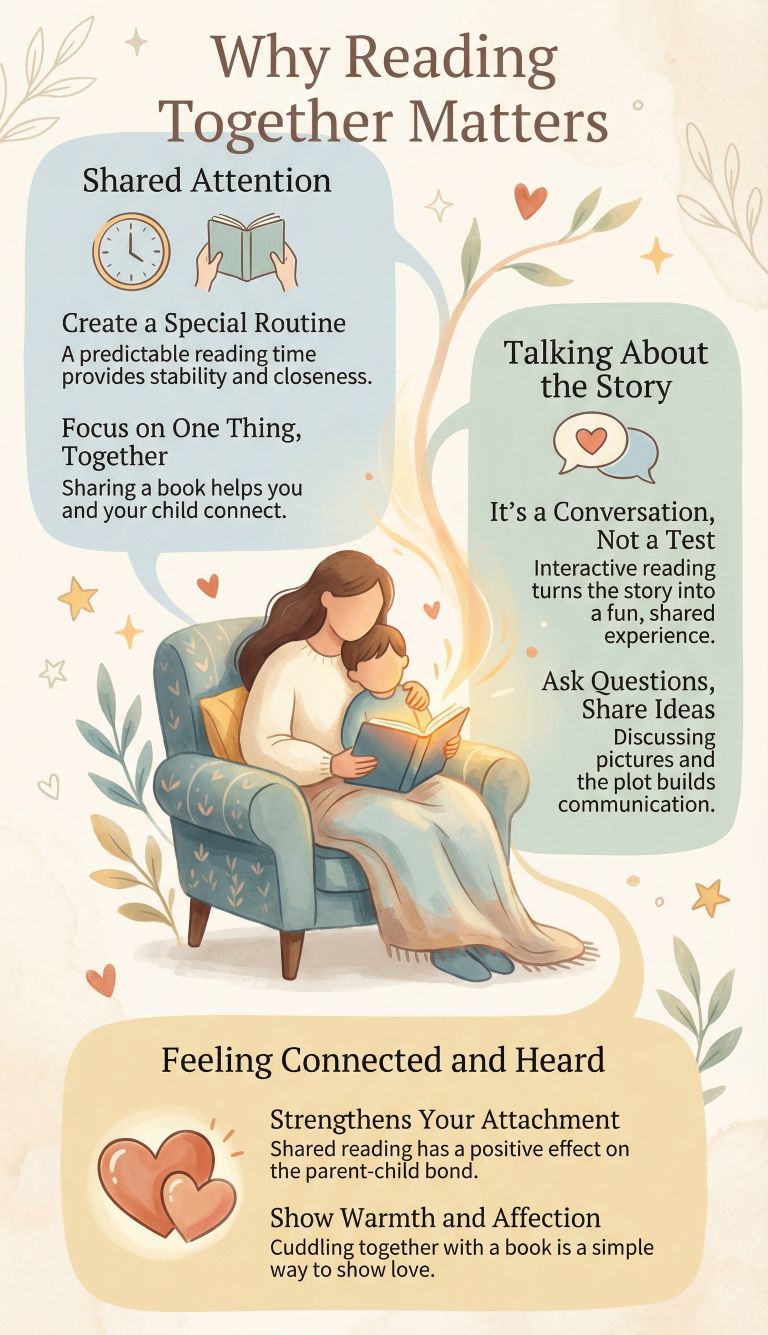 Why reading together matters: shared attention, conversation, and closeness turn reading into meaningful quality time.
Want the product overview of MIBOOKO Storybook (the endless storybook for kids)? Explore it here →
More Than Words: The Science of Bonding
When you read with your child, you aren’t just processing text; you are engaging in a complex emotional dance. Research using functional MRI scans has shown that the quality of shared reading—specifically the warmth and interactivity of the parent—correlates with higher activation in brain areas responsible for social-emotional integration and empathy.
Simply put, when you share a story, your child’s brain is practicing how to relate to others.
The Science Bit:
Studies on storytelling in stressful environments (like hospitals) have shown that engaging in narratives can significantly increase oxytocin (the “love” or bonding hormone) and decrease cortisol (the stress hormone). When you read together, you are biologically regulating your child’s stress response, creating a “safe harbour” that helps them feel secure.
It’s Not a Lecture, It’s a Conversation
Have you ever paused in the middle of a sentence because your child wanted to point out a squirrel in the background of a picture? It might feel like an interruption, but psychologists call this “Dialogic Reading,” and it is the gold standard for shared reading.
Dialogic reading shifts the child’s role from a passive listener to an active storyteller. Instead of reading straight through, you ask open-ended questions (“What do you think will happen next?”) or expand on what they say (“Yes, that is a truck. It’s a red fire truck!”).
Research indicates that this back-and-forth interaction is what drives development. Children who actively participate in the storytelling process show greater gains in expressive language and are more engaged than those who simply listen.
Active Connection vs. Passive Consumption
In our digital age, it is tempting to hand a child a tablet with an audiobook or an animated story. While these tools have their place, they often lack the “active ingredient” of early development: you.
Recent neuroimaging studies have found that high levels of independent screen use in early childhood can be linked to lower connectivity between brain networks responsible for attention and cognitive control. However, the research also offers a reassuring solution: parent-child reading can act as a buffer. When parents read with their children, it moderates these associations, potentially protecting the brain’s network development.
The difference lies in the “serve and return” nature of human interaction. A screen cannot see your child’s confusion and pause to explain, nor can it smile when your child laughs. That human reciprocity builds the neural architecture for social competence.
Making It Routine
Consistency is key. Establishing a regular family routine—like a nightly story—does more than just get them to sleep; it provides a predictable structure that fosters a sense of belonging and family cohesion. Even in busy or stressful times, preserving this small ritual can protect your child’s social and cognitive development.
Sometimes, parents feel fatigue or lack confidence in their storytelling skills. This is where structured story experiences can be helpful. Tools designed to be shared, such as the MIBOOKO Storybook, can provide a framework that guides the parent and child through a narrative together, ensuring the experience remains interactive and focused on connection rather than passive viewing.
If you’d like the parent guide to the endless storybook approach, start here →
Practical Takeaways for Tonight
You don’t need to be a teacher or an actor to be great at shared reading. Here are three simple, research-backed tips:
Follow Their Lead:
If your child wants to skip pages or talk about the pictures, let them. The goal is engagement, not finishing the book. Children’s autonomy in choosing books and directing the pace fosters greater interest.
Use the “PEER” Sequence:
Prompt your child to say something about the book, Evaluate their response (e.g., “That’s right!”), Expand on it (“It’s a big, blue ball!”), and Repeat the expansion to ensure they heard it.
Cuddle Up:
Physical proximity is a huge part of the benefit. The safety of your lap combined with the story creates a powerful association between reading and love.
Tonight, when you open that book, remember: you aren’t just teaching them to read. You are teaching them that they are safe, heard, and loved.
References
Brockington, G., Moreira, A. P. G., Buso, M. S., da Silva, S. G., Altszyler, E., Fischer, R., & Moll, J. (2021). Storytelling increases oxytocin and positive emotions and decreases cortisol and pain in hospitalized children. Proceedings of the National Academy of Sciences, 118(22), e2018409118.
Ferretti, L. K. (2011). The influence of family routines on the resilience of low-income preschoolers [Master’s thesis, Auburn University]. Auburn University Electronic Theses and Dissertations.
Huang, P., Chan, S. Y., Ngoh, Z. M., Ong, Z. Y., Low, X. Z., Law, E. C., Gluckman, P. D., Kee, M. Z. L., Fortier, M. V., Chong, Y. S., Zhou, J. H., Meaney, M. J., & Tan, A. P. (2024). Screen time, brain network development and socio-emotional competence in childhood: Moderation of associations by parent–child reading. Psychological Medicine, 54(9), 1992–2003.
Hutton, J. S., Phelan, K., Horowitz-Kraus, T., Dudley, J., Altaye, M., DeWitt, T., & Holland, S. K. (2017). Shared reading quality and brain activation during story listening in preschool-age children. The Journal of Pediatrics, 191, 204–211.
Meri, R., Hutton, J., Farah, R., DiFrancesco, M., Gozman, L., & Horowitz-Kraus, T. (2023). Higher access to screens is related to decreased functional connectivity between neural networks associated with basic attention skills and cognitive control in children. Child Neuropsychology, 29(4), 666–685.
Nan, J., & Tian, Y. (2025). Parent–child shared book reading challenges and facilitators: A systematic review and meta synthesis. Frontiers in Psychology, 16, 1635956.
Pillinger, C., & Vardy, E. J. (2022). The story so far: A systematic review of the dialogic reading literature. Journal of Research in Reading, 45(4), 533–548.