















“Do you want the red cup or the blue cup?”
This article is part of the MIBOOKO Storybook series (endless storybook for kids). Start with the parent guide →
It seems like such a small question. To an adult, the color of the cup barely matters. But to a toddler or a young child, this question is an invitation to take the wheel. It signals that their opinion counts and that they have the power to change a small part of their world.
As parents, we often walk a tightrope between maintaining necessary boundaries and fostering independence. While it might be faster to just hand them the blue cup, developmental psychology suggests that offering these small, guided moments of choice is a critical ingredient for building a confident, resilient mind.
Here is a look at why letting children decide matters, and how you can support their growing autonomy without losing control of the routine.
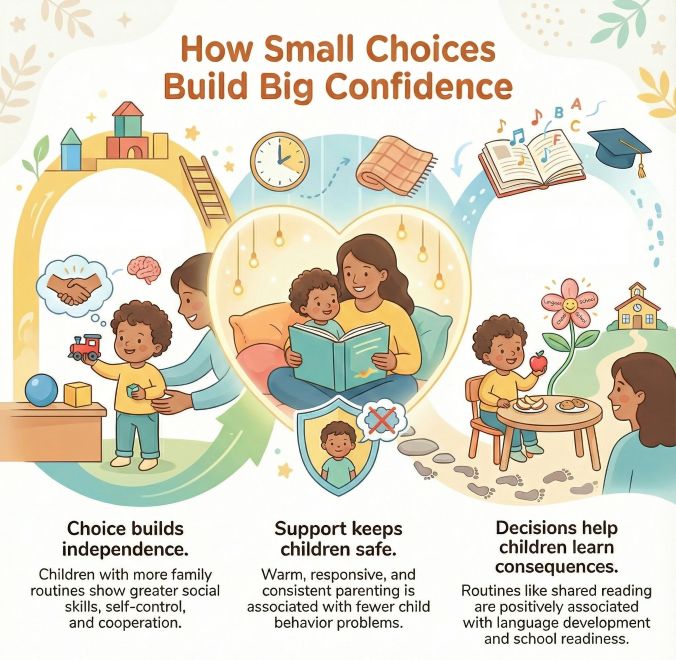 How small choices build big confidence: supported decisions help children feel independent, safe, and capable.
Want the product overview of MIBOOKO Storybook (the endless storybook for kids)? Explore it here →
The Science of “I Can Do It”
In child psychology, we talk about a concept called agency. This isn’t just about doing what you want; it is the fundamental belief that your actions have an impact on the outcome. When a child creates a drawing, builds a tower, or chooses a book, they are testing their ability to influence their environment.
Research shows that a child’s sense of agency is tightly linked to their well-being and their motivation to learn. Children who believe they can affect outcomes—a concept known as “self-efficacy”—tend to have better school adjustment and healthier emotional regulation. When we offer choices, we aren’t just being nice; we are helping them build the internal belief that they are capable participants in their own lives, rather than passive observers.
Think of it this way:
If life were a car ride, a child with low agency feels like they are strapped in the back seat with tinted windows. A child with supported agency feels like they are in the front seat, holding a map, helping to navigate.
The “Goldilocks” Zone: Guided Choice vs. Free Rein
There is a big difference between “autonomy support” (which is healthy) and total freedom (which can be overwhelming).
If you ask a five-year-old, “What do you want for dinner?”, they might freeze, or suggest ice cream. This is an unguided choice that exceeds their developmental capacity. However, if you ask, “Do you want carrots or peas with your chicken?”, you provide a structured environment where they can succeed.
Developmental studies suggest that children’s experience of agency changes depending on who they are with. They often feel they have the most “power” with peers, but perceive less agency with adults, like teachers or parents. To bridge this gap, parents can use “scaffolding”—providing a safe structure (the bumpers in the bowling lane) within which the child can freely direct the ball. This supports their intrinsic motivation—the desire to do things because they find them interesting or satisfying, rather than just to please an adult.
Practicing Decisions in Story Worlds
One of the safest and most effective places for children to practice making decisions is within the world of stories.
Recent research into interactive narratives (often called the “ACORN” method in studies) has found that when children are given agency—such as deciding what a character should do next or choosing a path in a story—their engagement skyrockets. In one study involving 4th to 6th graders, children who used an interactive storytelling app where their choices influenced the narrative reported a significantly higher sense of ownership over their learning compared to those who just read a linear story.
This concept of “deciding together what happens next” allows children to simulate decision-making without real-world risk. They can explore cause and effect: “If we help the squirrel, what happens to the acorns?” This is where tools designed for parent-child interaction can be valuable. For example, the MIBOOKO Storybook is one such tool that structures narrative choices, allowing parents and children to pause and navigate a story’s path together. This shared decision-making turns reading from a passive intake of words into an active training ground for critical thinking.
Start with the MIBOOKO Storybook Guide if you want the full “how it works” loop (chapter endings → decide together → continue)
Building the Muscle
Giving your child choices doesn’t mean relinquishing your role as a parent. It means recognizing that decision-making is a muscle that needs to be exercised.
By allowing them to choose the red cup, pick the bedtime story, or decide which path a character should take, you are telling them, “I trust you.” And more importantly, you are teaching them to trust themselves.
References
Cheng, A. Y., Guo, M., Ran, M., Ranasaria, A., Sharma, A., Xie, A., … & Landay, J. A. (2025). ACORN: Creating Interactive Educational Stories that Adapt to Learners and Their Environments. Proceedings of the CHI Conference on Human Factors in Computing Systems.
Gurdal, S., & Sorbring, E. (2019). Children’s agency in parent–child, teacher–pupil and peer relationship contexts. International Journal of Qualitative Studies on Health and Well-being, 13(Sup 1), 1565239.
Froiland, J. M. (2020). Parental Autonomy and Relatedness Support. In F. C. Worrell, T. L. Hughes, & D. D. Dixson (Eds.), The Cambridge Handbook of Applied School Psychology (pp. 260–276). Cambridge University Press.