















Why Your Child Gets Lost in a Good Story (And Why It Matters)
This article is part of the MIBOOKO Storybook series (endless storybook for kids). Start with the parent guide →
Think about the difference between snacking on a handful of sweets and sitting down to a warm, home-cooked meal. The sweets give you a quick burst of energy, but the meal nourishes you and leaves you feeling settled.
In the digital age, children are often offered a “diet” of fragmented content—short, funny videos or random games that provide quick entertainment. However, you have likely noticed a difference when your child engages with a meaningful story. They quiet down. Their eyes change focus. They might talk about the characters as if they are real friends.
From a developmental psychology perspective, this isn’t just about entertainment preferences. It is about how the developing brain builds meaning, identity, and emotional security. Here is what the research tells us about why meaningful stories resonate so deeply with children compared to random content.
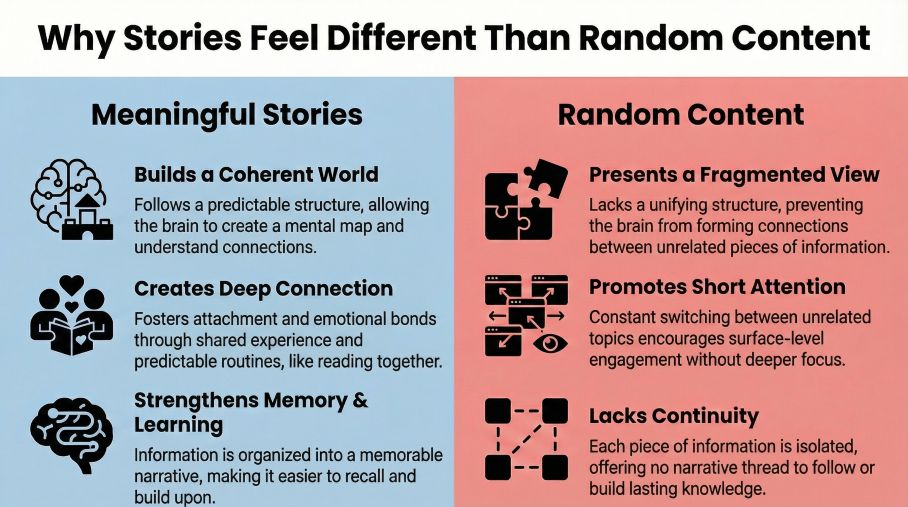 Why stories feel different than random content: meaningful stories build structure, connection, and memory, while random content remains fragmented.
Want the product overview of MIBOOKO Storybook (the endless storybook for kids)? Explore it here →
Making Sense of the World
Children are not passive observers; they are active meaning-makers. In psychology, we talk about “schema theory,” which explains that the brain organizes knowledge into frameworks or patterns. When a child encounters random content, their brain has to constantly work to create new context. It is exhausting.
However, a meaningful narrative provides a structure. It has a beginning, middle, and end. It uses cause and effect. When children engage with a story, they are not just watching events; they are practicing how to integrate new information into their existing understanding of the world. This supports identity development, as children “try on” the bravery, kindness, or problem-solving skills of the characters they meet, asking themselves, “What would I do?”
The “Friendship” Factor
Have you ever noticed your child greeting a favorite character like an old pal? Researchers call this a “parasocial relationship”—a one-sided but emotionally profound bond where the child feels a sense of friendship and trust with a character.
Research shows that these relationships are vital for learning. Children are actually more likely to learn academic or social lessons when they are taught by a character they feel emotionally attached to. Random content rarely allows time for this trust to build. In contrast, a consistent story world allows the child to move past “who is that?” and focus on “what are we doing together?” This deepens their engagement and allows them to explore complex emotions like empathy within a safe, trusted relationship.
Narrative vs. Noise: The Biological Difference
There is a distinct biological difference between processing fragmented content (like a series of unrelated jokes or puzzles) and being immersed in a narrative.
In a fascinating study regarding hospitalized children, researchers compared the effects of storytelling against solving riddles. While both activities involved attention, the storytelling sessions significantly increased oxytocin (the hormone associated with bonding and calm) and decreased cortisol (the stress hormone) and pain levels. The fragmented riddles did not have the same powerful physiological effect.
This suggests that the “narrative transportation”—the act of getting lost in a story—acts as a buffer against stress. When a child enters a cohesive story world, their nervous system can regulate and relax in a way that rapid-fire, random media does not allow.
The Value of the “Storybook Experience”
In early childhood, repetition and continuity are friends of development. When a story continues over time, or when a child revisits the same story world, they benefit from what researchers call “narrow viewing” or narrative continuity. Because they already know the setting and the characters, their cognitive energy is freed up to understand deeper plot points, new vocabulary, and subtle emotional cues.
This is why a structured storybook experience is often more developmentally supportive than an app full of unconnected mini-games. Platforms that respect this need for continuity—such as the MIBOOKO Storybook, which is designed to guide children through a consistent, evolving narrative—align well with how children’s brains naturally learn and find comfort. By stepping back into a familiar world, the child feels a sense of agency and belonging.
A Reassuring Thought
If your child asks for the same story again, or seems deeply invested in the life of a specific character, know that this is a healthy, productive part of their growth. They aren’t just being entertained; they are building a mental and emotional architecture that helps them understand themselves and the world around them.
If you want the full explanation of how an endless storybook works chapter-by-chapter, read the MIBOOKO Storybook Guide →
References
Canney, G., & Winograd, P. (1979). Schemata for reading and reading comprehension performance. University of Illinois at Urbana-Champaign, Center for the Study of Reading.
Digital Wellness Lab. (2023). Children & artificial intelligence: Research brief. Boston Children’s Hospital.
Aguiar, N. R., Richards, M. N., Bond, B. J., Brunick, K. L., & Calvert, S. L. (2018). Parents’ perceptions of their children’s parasocial relationships: The recontact study. Imagination, Cognition and Personality, 38(4), 1–29.
Calvert, S. L., Putnam, M. M., Aguiar, N. R., Ryan, R. M., Wright, C. A., Liu, Y. H. A., & Barba, E. (2020). Young children’s mathematical learning from intelligent characters. Child Development, 91(5), 1491–1508.
Brockington, G., Moreira, A. P. G., Buso, M. S., da Silva, S. G., Altszyler, E., Fischer, R., & Moll, J. (2021). Storytelling increases oxytocin and positive emotions and decreases cortisol and pain in hospitalized children. Proceedings of the National Academy of Sciences, 118(22), e2018409118.
Rodgers, M. P. H., & Webb, S. (2011). Narrow viewing: The vocabulary in related television programs. TESOL Quarterly, 45(4), 689–717.