















Why the “Never-Ending” Story is the Best Bedtime Routine for Your Child
This article is part of the MIBOOKO Storybook series (endless storybook for kids). Start with the parent guide →
Picture this: It’s 7:30 PM. The pyjamas are on, teeth are brushed, and the house is finally quieting down. You reach for a book on the shelf—maybe a new title you grabbed from the library. But your child pushes it away and asks, “Can we read about the little bear again? I want to know what he does next.”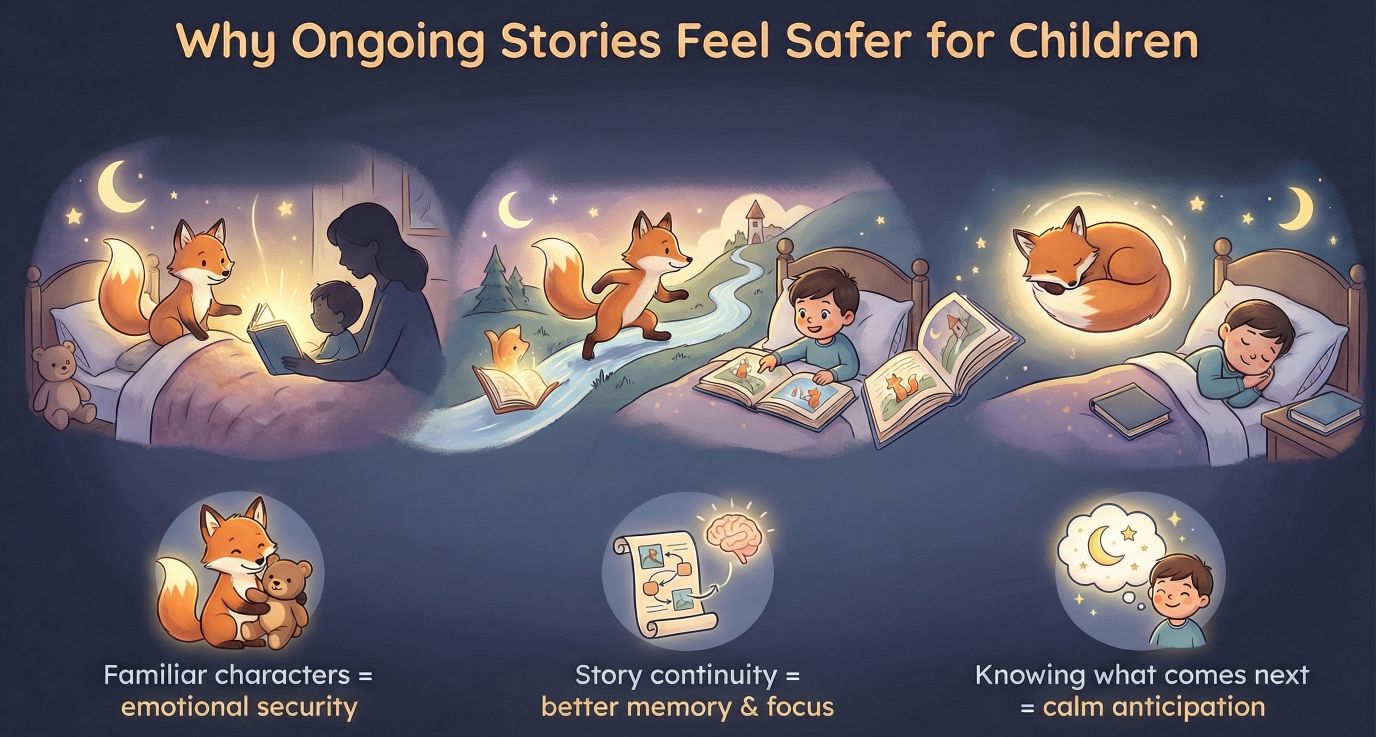
As parents, we often feel the pressure to introduce variety—new topics, new vocabulary, new lessons. However, developmental science suggests that your child’s instinct to stick with the same characters and a continuous story world is spot on. “Serial storytelling”—or narratives that continue over time—isn’t just comforting; it is a powerful engine for cognitive and emotional growth.
Here is a look at why ongoing narratives often benefit developing brains more than one-off stories, and how you can use endless storybook concept to support your child.
Want the product overview of MIBOOKO Storybook (the endless storybook for kids)? Explore it here →
The Comfort of a Familiar World
When a child enters a story with characters they already know, their brain doesn’t have to work overtime to learn the “rules” of that world from scratch. They already know the protagonist is kind, or that the forest is safe. This familiarity creates a sense of safety and predictability, which is crucial for emotional regulation.
In psychology, we talk about “schemas”—mental frameworks that help us organize knowledge. When a child engages with a familiar story world, they activate an existing schema, which reduces their “cognitive load” (the mental effort required to process information). Because they aren’t wasting energy figuring out who is who, they can focus on higher-level thinking, such as predicting plot points or understanding complex emotions.
The Science Bit:
Research on “schema theory” suggests that when children can slot new information into an existing mental framework (like a familiar story world), they comprehend the text more efficiently and retain information better than when they are constantly code-switching between unrelated stories.
Why “Imaginary” Friends Matter
You might notice your child talks about a book character as if they are a real friend. Psychologists call this a “parasocial relationship.” It is a one-sided but deeply emotional bond where the child trusts and cares for a character.
Far from being just a cute quirk, these attachments are vital for learning. Research shows that children are more likely to learn mathematical or social lessons when they are taught by a character they feel emotionally close to. When a story continues over days or weeks, that trust deepens. The character becomes a secure base from which your child can explore complex emotions without feeling personally threatened.
The Science Bit:
Studies indicate that when children form a “friendship” (attachment) with a character, they perform better on learning tasks and transfer those lessons to real-world objects more effectively than when interacting with neutral or unfamiliar characters.
The Power of “What Happens Next?”
One-off stories usually wrap up neatly in twenty pages. But stories that continue over time tap into a powerful cognitive tool: anticipation. When a child engages with a serial narrative—sometimes called the “Narrow Viewing” hypothesis in language research—they accumulate knowledge about the recurring characters.
Because they know the characters’ personalities, they can predict how those characters might react to a new problem. This act of prediction keeps the brain highly engaged and focused. Furthermore, engaging in these ongoing narratives supports “narrative transportation”—the feeling of being completely immersed in a story. This immersion has real physiological benefits: studies on children in high-stress environments (like hospitals) found that listening to immersive stories raised oxytocin (the bonding hormone) and lowered cortisol (the stress hormone) significantly more than non-narrative riddles.
The Science Bit:
Research on “narrative transportation” shows that becoming immersed in a story can reduce pain perception and stress biomarkers. The continuity of a story helps sustain this immersion, allowing the brain to shift from “fight or flight” to a state of calm and connection.
Building a Thread vs. Gathering Scraps
In early childhood, there is a distinct difference between fragmented storytelling (random, unconnected books) and ongoing narratives. Fragmented storytelling is like looking at a pile of snapshots; ongoing narratives are like watching a movie.
Recent research highlights the benefits of an “endless storybook” approach, where the narrative thread creates a continuous journey. While variety is healthy, a constant shifting of worlds can disrupt the deep engagement needed for developing “agency”—the sense that one’s thoughts and predictions matter. Tools that support this continuity can be very helpful for parents. For instance, the MIBOOKO Storybook is one example of a platform designed to create a structured, ongoing story experience that evolves, allowing children to stay within a consistent narrative framework rather than restarting the cognitive process every night.
For the full explanation of the MIBOOKO Storybook (endless storybook) format, read the parent guide →
The Science Bit:
Neuroimaging studies suggest that consistent shared reading strengthens the white matter tracts in the brain responsible for language and imagery. High-quality reading interactions—specifically those that encourage dialogue and continuity—are associated with more robust brain network integration compared to random or passive media consumption.
A Note for Tonight on Endless Storybook For Kids
Tonight, if your child asks for that same character or wants to know what happens next in a long-running saga, say yes. You aren’t just repeating a routine; you are building a secure emotional world where their brain is free to predict, learn, and grow.
References
Canney, G., & Winograd, P. (1979). Schemata for reading and reading comprehension performance (Technical Report No. 120). University of Illinois at Urbana-Champaign, Center for the Study of Reading.
An, S. (2013). Schema theory in reading. Theory and Practice in Language Studies, 3(1), 130–134.
Calvert, S. L., Putnam, M. M., Aguiar, N. R., Ryan, R. M., Wright, C. A., Liu, Y. H. A., & Barba, E. (2020). Young children’s mathematical learning from intelligent characters. Child Development, 91(5), 1491–1508.
Aguiar, N. R., Richards, M. N., Bond, B. J., Brunick, K. L., & Calvert, S. L. (2018). Parents’ perceptions of their children’s parasocial relationships: The recontact study. Imagination, Cognition and Personality, 38(4), 1–29.
Digital Wellness Lab. (2023). Children & artificial intelligence: Research brief. Boston Children’s Hospital.
Rodgers, M. P. H., & Webb, S. (2011). Narrow viewing: The vocabulary in related television programs. TESOL Quarterly, 45(4), 689–717.
Brockington, G., Moreira, A. P. G., Buso, M. S., da Silva, S. G., Altszyler, E., Fischer, R., & Moll, J. (2021). Storytelling increases oxytocin and positive emotions and decreases cortisol and pain in hospitalized children. Proceedings of the National Academy of Sciences, 118(22), e2018409118.
Sparrow, A. (2025). Storytelling and pain relief. NeuLine Health. https://neulinehealth.com/storytelling-and-pain-relief/
Gurdal, S., & Sorbring, E. (2019). Children’s agency in parent–child, teacher–pupil and peer relationship contexts. International Journal of Qualitative Studies on Health and Well-being, 13(Sup 1), 1565239.
Hutton, J. S., Dudley, J., Horowitz-Kraus, T., DeWitt, T., & Holland, S. K. (2020). Associations between screen-based media use and brain white matter integrity in preschool-aged children. JAMA Pediatrics, 174(1), e193869.
Hutton, J. S., Phelan, K., Horowitz-Kraus, T., Dudley, J., Altaye, M., DeWitt, T., & Holland, S. K. (2017). Shared reading quality and brain activation during story listening in preschool-age children. The Journal of Pediatrics, 191, 204–211.
Nan, J., & Tian, Y. (2025). Parent–child shared book reading challenges and facilitators: A systematic review and meta synthesis. Frontiers in Psychology, 16, 1635956.
Perdina, S., & Maulidia, P. (2025). Bedtime stories in the Industry 4.0 era: A descriptive study of parents’ practices and perceptions in Pontianak. Mimbar Agama dan Budaya, 42(2), 472–482.