















Personalized Storybooks for Kids — The Complete Guide for Parents
Every child deserves a story where they are the hero.
Personalized storybooks transform ordinary reading time into an unforgettable ritual of connection, emotional growth, and imagination.
MIBOOKO creates hyper-personalized, psychologist-guided stories that help children explore confidence, empathy, and resilience — all through magical storytelling.
Introduction: What Are Personalized Storybooks?
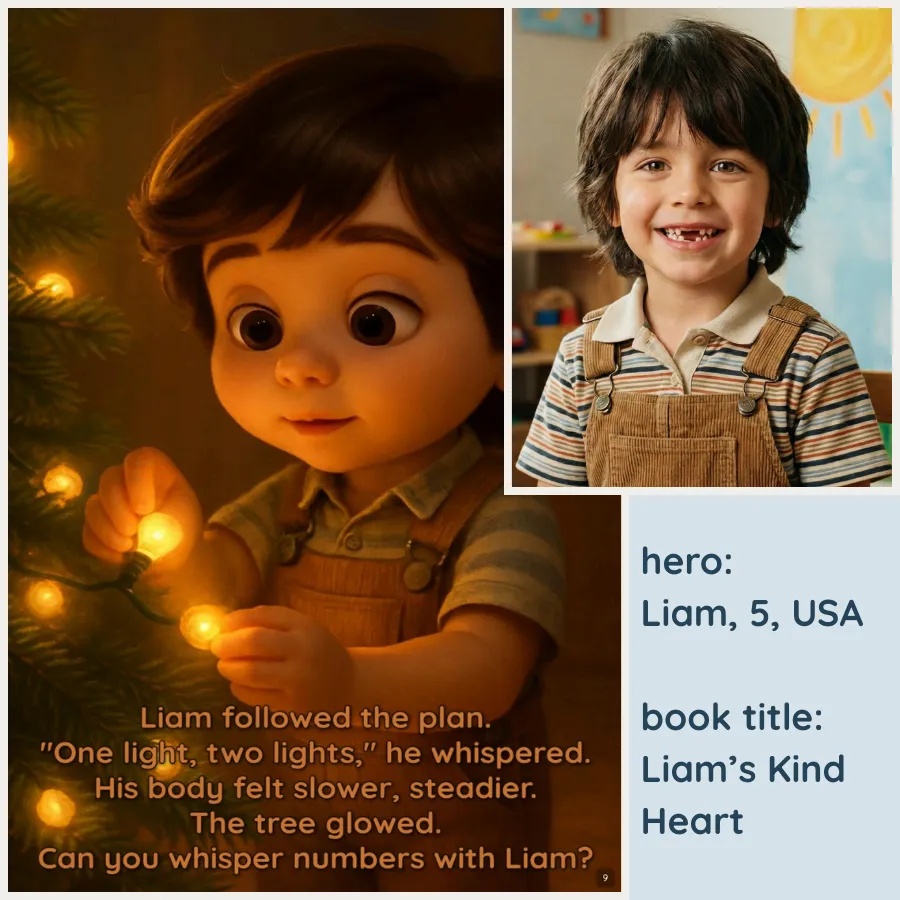
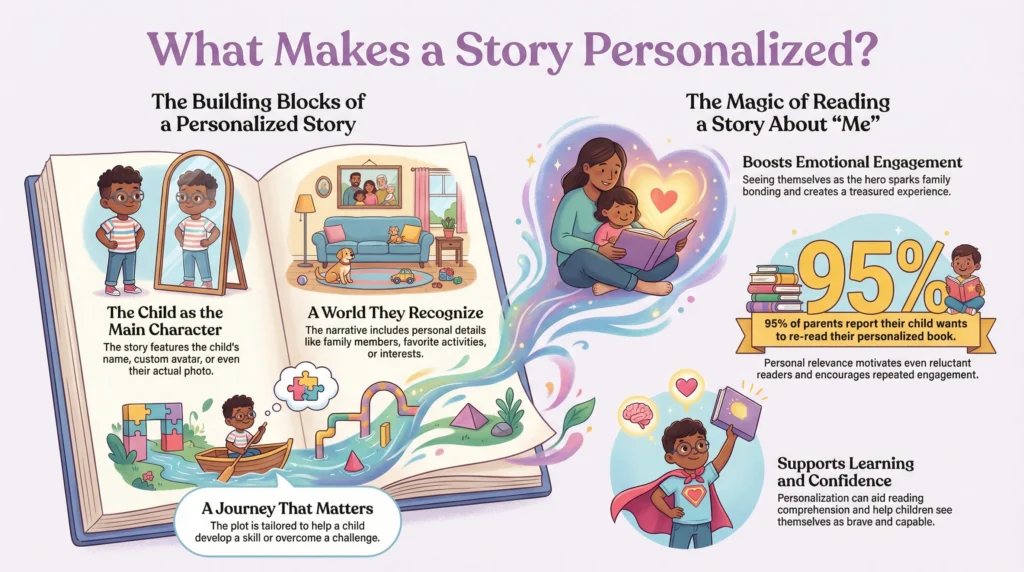
Personalized storybooks are books where the child becomes the center of the narrative. Their name, appearance, interests, and sometimes even family members appear directly in the story — creating a sense of ownership and emotional engagement far beyond traditional books.
Today’s personalized books go beyond name insertion. With advanced creative technology, stories adapt to a child’s:
- Personality and emotional needs
- Aspirations
- Cultural background
- Reading level
- Preferred themes
- Learning goals
Why Personalized Storybooks Matter
Personalized stories do more than entertain — they reinforce a child’s emotional development and learning in ways traditional books can’t.
Emotional Benefits
Strengthens the child’s identity and self-esteem
Helps them process feelings through familiar, safe scenarios
Encourages empathy, kindness, and positive values
Reduces bedtime anxiety through predictability and personalization
Want story ideas that gently build confidence, empathy, and emotional vocabulary? Explore our guide to emotional growth stories for children ->
Cognitive Benefits
Higher reading engagement and attention span
Improved comprehension and memory retention
Earlier development of narrative understanding
Stronger association between reading and positive emotions
Personalized storybooks offer unique cognitive and emotional advantages for early readers. You can explore these insights in depth in our article on 10 benefits of personalized storybooks for child development ->
Parent–Child Connection
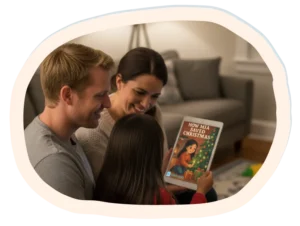
Personalized storybooks turn reading time into a shared ritual — a moment of closeness that improves emotional security and attachment.
Types of Personalized Storybooks
Personalization comes in different forms. Understanding them helps parents choose what suits their child best
Digital Personalized Storybooks
Interactive, instant, and easy to update with new content.
AI-Enhanced Personalized Storybooks
These dynamically adjust story elements such as:
Themes
Emotional focus
Story length
Character roles
AI helps generate fresh content while maintaining narrative safety and age-appropriate framing.
If you’re researching this category, read our parent-friendly overview of AI storybooks for kids (including what to look for in safe, age-appropriate design).
Print-at-Home Books
Convenient and eco-friendly. Parents can print keepsake versions or create DIY books together.
Premium Printed Editions
Hardcover or softcover storybooks designed as gifts or special moments.
Considering a physical keepsake or a gift? See our guide to printed personalized kids books (what parents choose and why).
How Personalized Storytelling Works
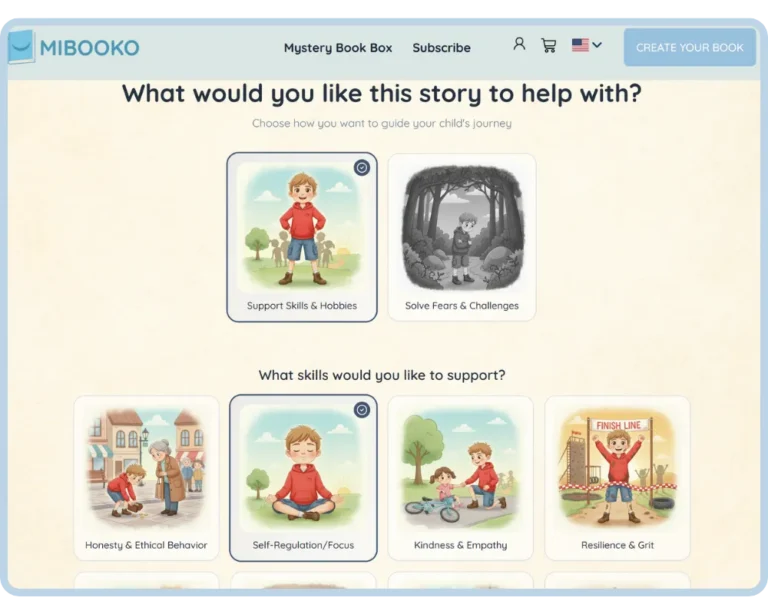
Modern storytelling platforms personalize much more than a name. Customization may include:
Child’s avatar (appearance, clothing, hair, skin tone)
Emotional themes (confidence, courage, friendship, curiosity)
Preferred environments (jungle, space, underwater, magical forests)
Tone of the story (gentle, adventurous, humorous)
Sibling or parent characters
Cultural context (languages, names, heritage)
Personalized storytelling helps children understand emotions, build confidence, and stay deeply
engaged. You can learn more about how personalization increases reading focus and motivation in
our article on how personalized stories boost reading engagement in kids.
How to Choose the Right Storybook for Your Child
Choosing the right storybook depends on the child’s age, emotional needs, and interests.
By Age
- 0–2 years: Mainly visuals. Just a few words per page.
- 3–5 years: Short, simple stories with strong visuals
- 6–9 years: Confidence-building, adventure, early moral lessons
10 years and older: Problem-solving, curiosity-driven narratives
By Emotional Need
Confidence: Hero stories + success loops
Empathy: Friendship and teamwork stories
Bedtime anxiety: Gentle, predictable stories with soothing tone
Resilience: Stories where characters face challenges safely
By Interests
Animals, space, magic, sports, music — personalization adapts to each theme.
Personalized Storybooks vs Traditional Kids’ Books
Parents often ask: Why not just use regular books?
Here is the key difference:
| Feature | Traditional Books | Personalized Storybooks |
|---|---|---|
| Engagement | Medium | Very high |
| Emotional impact | Generic | Tailored to child |
| Learning retention | Moderate | Higher due to self-relevance |
| Adaptability | None | Fully customizable |
| Connection | Passive reading | Interactive co-creation |
Why MIBOOKO Is Different
Anyone can generate a story with AI — but not all AI is safe, emotionally structured, or developmentally appropriate.
Psychologist-Reviewed Story Frameworks
Stories are reviewed to support emotional development, not overwhelm the child.
Safe AI with No Hallucinations
The system is designed to prevent frightening or inappropriate content.
Deep Personalization
Child becomes the hero through multi-layer personalization:
Avatar builder
Family and friends
Emotional themes
Multiple languages
A Ritual, Not a Screen
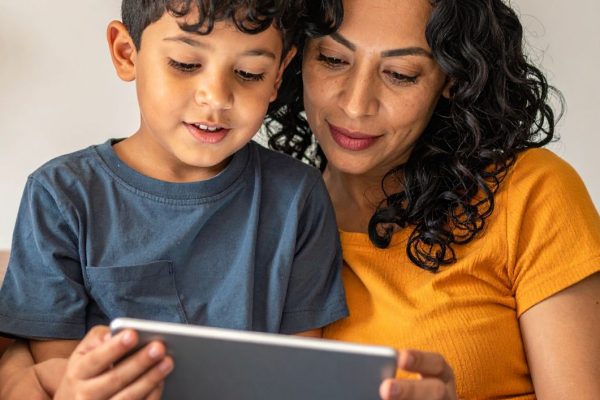
MIBOOKO transforms screen time into meaningful shared reading time.
Learn more about how personalized storytelling supports emotional growth, confidence, and early
cognitive development in our article on the benefits of personalized storybooks for child development.
FAQ
Yes. Personalized storybooks are exceptionally beneficial for child development because they activate a learning mechanism known as “self-relevance.”
When children see themselves reflected in a story — through their name, avatar, culture, emotions, or daily experiences — their attention, comprehension, and emotional engagement increase significantly compared to generic stories.
From a developmental perspective, personalized narratives support:
- Early literacy: Children engage longer, ask more questions, and follow stories with greater interest.
- Memory retention: Kids remember events better when they personally identify with the hero.
- Emotional intelligence: Personalized stories create safe spaces for children to explore confidence, empathy, courage, and problem-solving.
- Identity formation: Seeing themselves as the hero strengthens self-esteem and helps children develop a positive sense of self.
- Parent–child connection: Reading together becomes a ritual that builds emotional security.
Psychologists consistently highlight that stories where children recognize themselves have deeper emotional and cognitive impact.
As early as possible — even toddlers can benefit — as long as the storyline complexity is adapted to the child’s developmental stage.
For ages 18 months to 3 years, personalization focuses on:
simple language,
rhythm and repetition,
strong visual cues,
gentle emotional themes.
For ages 4–7, personalization becomes more meaningful because children begin:
connecting emotions to outcomes,
identifying with characters,
preferring stories that reflect their family or interests.
For ages 8–10, personalized stories help:
build confidence,
support resilience,
develop empathy,
introduce moral decision-making through narrative choices.
There is no “too early” or “too late” — personalization simply adapts to the child’s age, reading level, and emotional needs.
They can be extremely safe — when built on a controlled, psychologist-informed framework.
Not all AI tools are appropriate for children, which is why safety design matters.
A safe AI storytelling system must include:
Content filters that prevent frightening, harmful, or age-inappropriate themes.
Emotionally-structured templates ensuring every story reinforces positive values and emotional stability.
Hallucination-prevention safeguards to avoid unpredictable or confusing narrative jumps.
Clear developmental guidelines aligned with early-childhood psychology.
Consistent tone and predictability to avoid overstimulation, especially before bedtime.
MIBOOKO was designed specifically for children, using guardrails and psychologist-reviewed parameters — ensuring stories stay supportive, calming, and age-appropriate.
Very much so — printed personalized books remain one of the most cherished gift categories for young children.
Parents and families choose printed editions because they offer:
A keepsake physical object that the child can revisit over years.
A break from screens, which many parents actively prefer.
A ritual experience, especially at bedtime, where physical books feel grounding and comforting.
Giftability, making them ideal for birthdays, holidays, and milestones.
Emotional permanence, since children often keep printed personalized books as treasured memories.
Even in the digital era, print personalization has grown — because the emotional value of seeing one’s name and identity inside a real book is unmatched.
Only a few minutes — but the effect lasts much longer.
Most parents complete personalization in 1–3 minutes by selecting:
the child’s name,
avatar appearance,
story theme,
emotional focus (confidence, courage, empathy, friendship),
language and story length.
Once personalization is done, the story is generated instantly, and parents can:
read it digitally,
print it at home, or
order a printed edition (if available).
The speed and simplicity are intentional: personalization should be fun, intuitive, and accessible to every parent — without technical complexity.
Personalized stories can support a wide range of emotional and developmental themes, tailored to the child’s current needs.
Common themes include:
Confidence & bravery — overcoming small challenges
Empathy & kindness — helping friends, resolving conflicts
Resilience — trying again after setbacks
Friendship — building relationships and trust
Curiosity & exploration — discovering new worlds
Bedtime calm — gentle, soothing narratives for evening routines
Because the story centers the child, these themes feel personal and directly relevant — reinforcing the lessons in a natural, supportive way.
Yes. Personalized storybooks are one of the most effective early tools for building a child’s confidence because they place the child at the center of the narrative, turning everyday challenges into achievable victories.
When children see themselves as the main character who:
solves problems,
makes brave choices,
helps others,
or reaches meaningful goals,
they internalize those capabilities as real possibilities in their own lives.
Psychologists call this self-efficacy reinforcement — when a child repeatedly sees a version of themselves succeeding, they begin to believe they can succeed outside the story as well.
Personalized stories support confidence through:
Predictable success loops (the child always triumphs safely)
Positive reinforcement embedded in the plot
Age-appropriate challenges that never overwhelm
Safe exposure to emotions such as nervousness, excitement, or uncertainty
A sense of belonging and identity
This is why many parents use personalized stories to support transitions like:
starting preschool,
meeting new friends,
beginning sports or activities,
handling bedtime fears.
The emotional modeling inside the story becomes a rehearsal for real life.
Personalization greatly increases reading engagement because the child immediately recognizes themselves within the narrative — triggering deeper attention, curiosity, and emotional connection.
Several mechanisms make personalized stories more engaging:
1. Immediate Identity Recognition
When children hear their own name or see a familiar avatar, the brain registers the experience as personally meaningful. This increases focus and reduces distraction.
2. Emotional Relevance
Personalized stories reflect the child’s fears, joys, relationships, and interests. This relevance makes them more invested in what happens next.
3. Predictable Motivation
Children are naturally motivated to follow stories about themselves. This increases the likelihood of returning to the book multiple times, reinforcing reading habits.
4. Better Comprehension
When the main character is familiar, children spend less cognitive energy “understanding” who the story is about and more energy understanding what is happening.
5. Stronger Parent Engagement
Parents tend to read personalized stories with more expression and enthusiasm, which further increases a child’s involvement.
Research consistently shows that self-relevant content increases motivation, retention, and comprehension — turning reading from an obligation into something children want to do.
Yes — personalized storybooks are uniquely effective during bedtime because they combine emotional familiarity, gentle pacing, and predictable story arcs that help children feel safe and settled.
They support emotional regulation through:
1. Familiar Emotional Cues
Children see themselves navigating situations that mirror real emotions — worry, anticipation, curiosity, or calm — allowing them to practice emotional processing in a safe narrative environment.
2. Predictable Structure
Bedtime stories with personalization create a ritual. Children relax when routines are comforting and familiar.
3. Modeling Calm Behavior
When the story’s “hero” (the child) uses breathing, kindness, patience, or a soothing bedtime sequence, children mirror these behaviors subconsciously.
4. Anchoring Positive Feelings to Bedtime
Personalized stories associate bedtime with warmth, attention, and security — reducing nighttime resistance or anxiety.
5. Parent–Child Co-Regulation
Sharing a personalized story helps synchronize emotional states. Parents slow down, read with warmth, and create a safe emotional environment for the child.
This makes personalized bedtime stories especially beneficial for:
- children who resist sleep,
- children with nighttime worries,
- sensitive or emotionally reactive children,
- transitions (new home, new school, travel).
When bedtime becomes a shared, predictable ritual, children fall asleep more easily and feel more secure.