

























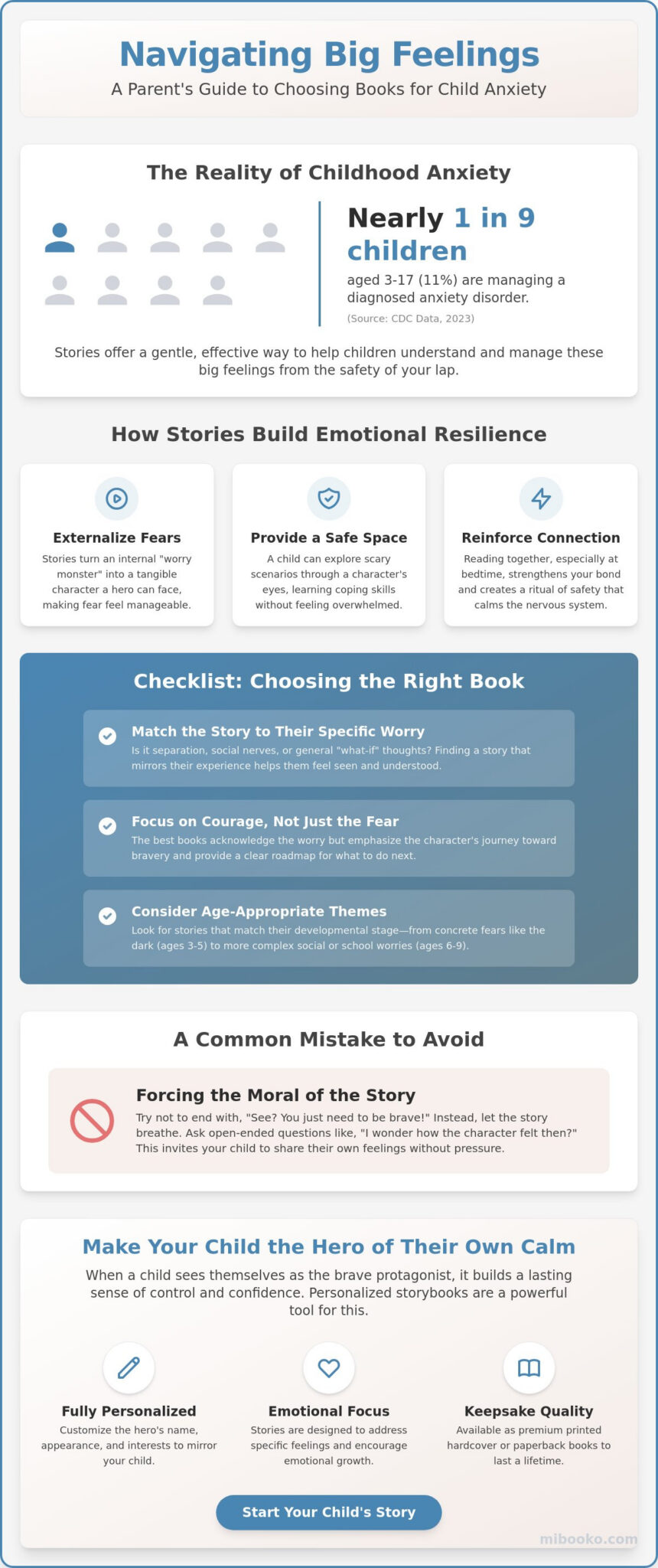
Nearly 11% of children aged 3 to 17 are currently managing a diagnosed anxiety disorder, according to 2023 CDC data. If you’ve spent your evenings sitting on the edge of a bed, trying to soothe a worry-spiral or a sudden fear of the dark, you know that these big feelings can feel overwhelming for both of you. It’s heartbreaking to see your little one struggle, and finding the right book to help child with anxiety often feels like searching for a needle in a haystack of generic choices.
You want more than just a distraction; you need a tool that builds real emotional resilience. This guide will help you discover carefully chosen stories that turn scary moments into opportunities for growth. We’ll explore top-rated titles like “The Invisible String” and “Worry Says What?”, and we’ll show you how a personalized storybook can make your child the hero of their own journey toward calm.
Key Takeaways
- Learn how stories act as a bridge to help your child externalize internal fears by seeing them reflected in a brave character.
- Identify the most effective book to help child with anxiety by matching story themes to their specific worries, such as separation or social nerves.
- Discover why focusing on a character’s courage and resilience is more supportive for building confidence than simply highlighting their fears.
- Avoid the common pitfall of forcing a moral lesson too early; instead, let the narrative naturally invite your child to share their feelings.
- Explore how making your child the hero of a personalized storybook can strengthen their sense of safety and emotional control during bedtime.
Table of Contents
Why Stories Are Essential Tools for Children Navigating Anxiety
Personalized Storytelling: Making Your Child the Hero of Their Own Calm
Why Stories Are Essential Tools for Children Navigating Anxiety
When a child feels anxious, their world can feel small and frightening. One of the most effective ways to expand that world again is through the therapeutic use of books, a practice known as bibliotherapy. This isn’t just about reading; it’s about providing a framework for emotional growth. A well-chosen book to help child with anxiety works by externalizing the struggle. Instead of the anxiety being a part of who they are, it becomes a character or a challenge that a protagonist faces. This shift is vital. It turns an internal, invisible monster into something tangible that can be discussed, understood, and eventually managed.
Stories provide a unique sense of safety. Your child can watch a character face a “worry monster” from the comfort of your lap. This distance allows them to explore scary scenarios without their brain’s alarm system going off. They learn that feelings are like weather; they arrive, they stay for a while, and then they pass. By observing how characters regulate their emotions, children begin to develop their own toolkit for emotional regulation. It’s a gentle way to practice courage before they have to use it in the real world.
The Science of Narrative Transportation
Narrative transportation happens when a reader becomes fully immersed in a story’s world. This immersion can help lower cortisol levels, moving the body from a state of “fight or flight” into a state of relaxation. Through mirroring, children see a character use a deep breath or a brave thought and realize they can do the same. Stories create a safe third space where you and your child can talk about the character’s fears instead of the child’s own, making the conversation feel much less threatening.
Why Bedtime is the Critical Window for Emotional Processing
Bedtime is often when “big feelings” come out to play. The quiet of the evening can make worries feel louder. However, this window is also the most effective time for emotional processing because your child feels secure in your presence. Reading together reinforces a sense of safety that counteracts the day’s stressors. Using personalized books for kids during this time can be especially powerful. When your child sees themselves as the hero who navigates a challenge, it builds a lasting sense of emotional confidence that carries into the next day.
How to Choose a Book to Help Your Child Manage Worry
Finding the right book to help child with anxiety starts with understanding the specific “flavor” of their worry. Anxiety isn’t a monolith; it manifests differently for every little one. Some children struggle with separation, feeling a deep ache when you leave the room. Others experience social anxiety, where the thought of a birthday party or a new classroom feels like a mountain they can’t climb. Generalized anxiety might look like a constant stream of “what if” questions that never seem to end. When you select a story that mirrors their specific experience, your child feels seen and understood, which is the first step toward calm.
Look for narratives that prioritize courage over the fear itself. While it’s helpful to acknowledge the “big feelings,” a truly supportive story provides a roadmap for what to do next. High-quality illustrations play a silent but vital role here. Opt for books with soothing color palettes and gentle line work that convey a sense of safety. Research from PBS highlights how reading with your child can reduce stress, especially when the book uses simple, age-appropriate language that doesn’t over-complicate the emotional experience. A well-chosen book to help child with anxiety acts as a gentle bridge between fear and confidence.
Matching the Story to Developmental Stages
Children’s needs evolve as they grow. For ages 3 to 5, look for stories that address concrete fears like the dark or being away from a caregiver. These books should use repetitive, soothing rhythms that provide a predictable sense of security. For kids aged 6 to 9, the focus often shifts to school-based worries, friendships, and internal “worry thoughts.” At this stage, choosing durable hardcover storybooks ensures the story can remain a trusted companion on their nightstand for years to come.
Narrative vs. Workbook: Which Does Your Child Need?
You might encounter many clinical workbooks designed to teach coping skills. While these are valuable, they can sometimes feel like “extra homework” to a child who is already feeling overwhelmed. A passive narrative provides comfort and allows your child to simply be. However, you can find a middle ground with stories that integrate skills and challenges directly into the plot. This approach teaches resilience through the hero’s actions rather than a checklist. If you want to make these lessons even more impactful, you can make your child the hero of their own book to help them visualize their own bravery.
Top Categories of Books for Anxious Kids in 2026
Selecting the right book to help child with anxiety can feel like a daunting task because there are so many “flavors” of worry. In 2026, parents have access to a rich landscape of stories, from timeless classics to modern, personalized adventures. The key is to choose a category that matches how your child processes information. Some kids need the comfort of a familiar metaphor, while others need to see themselves as the hero of the story to feel truly brave. This variety ensures you can find a tool that resonates with your child’s unique personality.
Classic titles like “The Invisible String” (available for $9.99) remain popular because they address the core of separation anxiety with a gentle, enduring message. If your child responds better to personified characters, modern picture books like “Worry Says What?” ($10.95) or “Wilma Jean the Worry Machine” ($7.79) use clever metaphors to externalize fears. These stories help kids view anxiety as something outside of themselves, which makes a book to help child with anxiety much more effective. By turning a feeling into a character, you give your child the power to interact with it differently. This approach is a cornerstone of the practice of bibliotherapy, where reading becomes a bridge to emotional resilience.
For children who struggle with visual overstimulation, audiobooks offer a screen-free way to relax. Listening to a calm voice narrate a story can lower their guard and allow the message of resilience to sink in deeply. This format is particularly helpful during moments of high stress when focusing on a page feels too difficult.
Narrative Picture Books for Younger Children (Ages 3-7)
Younger children often play the “What If” game, where their imagination runs wild with potential problems. Books for this age group should focus on repetitive breathing techniques and animal characters that model calm behavior. It’s essential that these stories have “safe” endings. A predictable, happy resolution ensures that the book provides comfort rather than introducing new worries before sleep. If your child is particularly sensitive, personalized audiobooks can create a soothing, screen-free environment that helps them drift off with a sense of security and peace.
Skill-Based Guides for School-Aged Kids (Ages 8-12)
As children grow, their anxiety often becomes more complex, involving school performance and social dynamics. Skill-based guides like “What to Do When You Worry Too Much” ($14.99) use Cognitive Behavioral Therapy (CBT) principles simplified for a young audience. These books teach kids to distinguish between the “size of the problem” and the “size of their reaction.” By encouraging children to “talk back” to their anxiety using character-based dialogue, these resources turn a scary feeling into a manageable interaction. This empowers them to take control of their thoughts rather than feeling controlled by them.
Common Mistakes to Avoid When Reading About Worry
Reading a book to help child with anxiety is a delicate process that requires more than just reciting words on a page. Even with the best intentions, it’s easy to turn a gentle bonding moment into a clinical exercise. One major mistake is forcing the “moral of the story” before your child is ready to hear it. If you rush to explain why a character shouldn’t be afraid, you might accidentally dismiss your child’s real feelings. Instead, let them lead the way. If they want to linger on a page where the character is hiding, let them stay there. Their pace tells you exactly what they’re processing in that moment.
Another common pitfall is choosing stories that inadvertently introduce brand-new fears. For example, a book meant to soothe a fear of the dark might mention specific things like “scary shadows” or “noises in the walls” that your child hadn’t previously noticed. This can accidentally expand their list of worries. Always pre-read a story to ensure it aligns with their current experience. Similarly, be mindful of your timing. While bedtime is a great window for connection, avoid high-tension scenes or intense illustrations right before the lights go out. Keep the evening focus on resolution, comfort, and safety.
The ‘Interrogation’ Trap: How to Talk After the Story
Avoid the temptation to turn storytime into a clinical interview. Asking direct questions like “Are you afraid of that too?” can make a child feel self-conscious or pressured to give a “right” answer. Use open-ended observations that focus on the character instead. You might say: “It looks like the hero’s tummy feels a little fluttery on this page; I wonder what they’ll do next to feel better?” This allows your child to identify with the emotion from a safe distance. It validates their feelings without over-emphasizing the anxiety itself as a permanent part of their identity.
Ensuring the Story Matches Your Family Values
Ensure the messaging in any book to help child with anxiety matches your specific parenting style. Some older stories rely on “tough it out” or “be a big kid” tropes that can make an anxious child feel ashamed of their struggle. Modern publishing focuses much more on validation and gentle coping strategies. This is why we prioritize methodology and safety in every narrative we create. By choosing stories that avoid photo uploads, you also protect your child’s privacy while encouraging them to use their own imagination to see themselves as the hero of the tale.
Ready to build a nighttime ritual that fosters lasting confidence? Create a printed keepsake storybook that centers on your child’s unique bravery and helps them navigate their world with ease.
Personalized Storytelling: Making Your Child the Hero of Their Own Calm
While off-the-shelf titles provide comfort, they can sometimes feel like stories about someone else. There’s a profound psychological shift that happens when a child sees their own name and a personalized illustrated hero on the page. This is called narrative identification. When you choose a book to help child with anxiety that features them as the protagonist, you’re not just reading a story; you’re providing a rehearsal for real-life bravery. Seeing themselves navigate a challenge helps bridge the gap between “I’m scared” and “I can do this.”
MIBOOKO allows you to select available story directions, interests, and personalization details for the adventure. This means the story isn’t just generic; it’s designed to support your child’s current struggle. By placing your little one in the role of the problem-solver, you help them visualize a version of themselves that is capable and calm. Over time, these stories become more than just entertainment. They act as a “courage anchor” that your child can return to whenever they feel a worry-spiral starting. When selecting a book to help child with anxiety, this level of personalization ensures the message sticks because it’s their own story.
Customizing the Narrative for Specific Challenges
Every child’s journey is different. You might be preparing for the first day of school or helping them navigate a new social situation. The MIBOOKO configurator lets you tailor the experience by including their specific interests, like space exploration or animals. This makes the bravery lesson feel like a fun adventure rather than a lecture. You can see how MIBOOKO works to understand how easy it is to create a story that speaks directly to your child’s heart.
Building a Library of Emotional Growth
Resilience isn’t built in a single night. It’s a continuous process of reinforcing a positive, capable identity. Having a library of stories where your child is always the hero helps them internalize the idea that they can handle whatever comes their way. While digital stories are convenient for travel, transitioning to premium physical copies provides a tactile sense of security. Holding a beautiful hardcover book creates a grounding, sensory experience that digital screens simply can’t match. It’s a permanent reminder of their own strength. Create a personalized storybook for your child and start building their collection of brave adventures today.
Building a Foundation of Bravery Through Stories
Helping your child navigate big feelings is a journey of patience and connection. You’ve learned how stories act as a bridge, allowing your little one to externalize their worries and practice courage from the safety of your lap. By matching a story to your child’s specific developmental stage and avoiding the common “interrogation” trap, you turn a simple bedtime routine into a powerful tool for emotional growth. The right book to help child with anxiety provides more than just comfort; it offers a roadmap for resilience that they’ll carry into adulthood.
When you make your child the hero of their own story, you reinforce their identity as a capable problem-solver. Our research-backed methodology ensures every narrative is age-appropriate and private; we require no photo uploads for deep personalization. Whether you choose a digital edition or a printed format available at checkout, you’re investing in a personalized story experience for your child. Create a personalized storybook for your child today and help them discover the hero within. You have everything you need to guide them toward a calmer, more confident tomorrow.
Frequently Asked Questions
Can reading a book about anxiety actually make my child more worried?
Reading a book to help child with anxiety won’t typically increase worry if the story focuses on coping strategies and resolution. If a book only highlights the scary parts without showing how the character feels better, it might feel too intense. Always look for stories that validate the feeling while offering a sense of safety and a clear path forward. Pre-reading the story yourself is a great way to ensure it matches your child’s current sensitivity level.
What is the best age to start reading stories about feelings to my child?
You can begin reading stories about feelings as early as age 2 or 3. This is the stage when children start to understand that others have emotions too. Starting early helps them build an emotional vocabulary so they can name their feelings before those feelings become overwhelming. Simple, repetitive stories with clear illustrations are best for this age group. They provide a predictable rhythm that helps your little one feel secure as they explore new concepts.
How do I know if a book is too ‘clinical’ for my child?
A book feels too clinical if it prioritizes medical terms or “to-do” lists over a compelling narrative. If the story feels like a lecture rather than a shared experience, your child might disengage or feel like they’re being “fixed.” Look for vibrant illustrations and characters that feel like real friends. The most effective stories are those where the emotional lesson is woven naturally into the plot rather than being the only focus of the book.
Is it better to read these books at bedtime or during the day?
Both times have unique benefits for your child’s emotional growth. Reading at bedtime reinforces a sense of safety and helps process the day’s events before sleep. However, reading during the day can be better for active skill-building because your child has more energy to talk about the story. You might find that a daytime reading session leads to better conversations, while a nighttime session provides the quiet comfort they need to drift off peacefully.
How can personalized books help with specific fears like the dark or starting school?
Personalized stories help by making the child the hero who successfully navigates their own world. When a child sees their name in a book to help child with anxiety, they internalize the character’s bravery as their own. This makes specific challenges like starting school or sleeping in the dark feel much more manageable. It turns an abstract fear into a story where they are already the winner, building their confidence before the real event even happens.
Should I choose a workbook or a storybook for a 7-year-old?
For a 7-year-old, a storybook is often the more nurturing and effective choice. Workbooks can feel like extra schoolwork, which might unintentionally increase stress for an already anxious child. A storybook allows them to relax into the narrative and learn through the character’s actions without the pressure of having to “perform.” If you want to include skill-building, look for a story that incorporates those techniques directly into the plot in a fun, engaging way.